


24 Sep Fire Door Safety Week: Ensuring Safety in Temporary Accommodation
This Fire Door Safety Week, we’re shining a light on the critical role fire doors play in keeping residents safe, particularly in temporary accommodation across London. Fire doors are much more than just regular doors; they are essential to protecting lives in the event of a fire. Fire doors slow the spread of fire, allowing people more time to escape safely, but only if they are installed and maintained properly.
London’s Setting the Standard property inspections service is leading the way in ensuring that temporary accommodation providers adhere to strict safety standards, including the correct installation and maintenance of fire doors. In recent years, catastrophic incidents such as the Grenfell Tower fire have tragically shown what can happen when fire safety standards are compromised. That’s why we are committed to ensuring that every fire door in temporary housing across London meets the highest standards.
Our Setting the Standard Inspection Officer, Ryan, talks us through the importance of fire doors and how they work:
“Fire doors are an integral part of fire safety in buildings from hospitals to offices to, of course, residential properties. Their purpose, as well as carrying out the normal functions of a door, is to:
- Limit the spread of fire by maintaining the compartmentation of buildings.
- Protect those escaping a fire by providing access to protected escape route without the loss of fire resistance.
- Limit smoke movement through a building.
Fire doors undergo rigorous testing in laboratory settings before they can be sold. This ensures they can resist fire for a required time period (usually 30 – 60 minutes). Testing is done by fixing a prepared doorset into a wall and exposing one face of the door to intense fire and heat (both sides of the door are tested).
Fire doors are installed using a very specific design that encompasses the whole doorset, including the door itself, surrounding walls, doorframe, hardware etc. Deviations from the tested design upon installation means there is no way of guaranteeing how the door will perform in the event of a fire, and could lead to serious harm or even death of people within the building.
General fire door checklist:
- Always install the door as per the manufacturer’s instructions
- It should fit tightly into the frame with no gaps larger than 3mm between the door and the door frame
- It should be hung on 3 fire-rated hinges (grade 11 or above)
- Fit intumescent strips and smoke seals to the 3 visible edges of the door
- Fit a fire-rated overhead self-closing mechanism and adjust the sweep and latch speed so that it can fully close the door and engage its latch from any closing position without slamming.
- It must be possible to unlock the door from the internal side without the use of a removeable key i.e. by fitting a thumb-turn lock.
- Repairs should only be carried out by an experienced fire door specialist or carpenter and should adhere to specific accepted repair techniques – if this cannot be achieved, the door should be replaced.
- Drop seals are a useful and simple solution to resolving an excessive gap between the foot of a fire door and the floor.
*Hinges, handles, and other ironmongery on fire doors are liable to warp in the high temperatures of fire, and therefore should be carefully chosen for the application.
Incorrectly installed Fire Door:
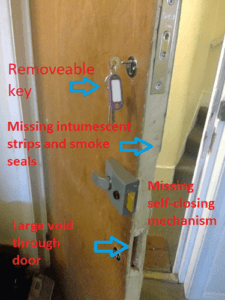
The British Standard for the code of practice for Fire-resisting and smoke control doors has recently been revised and offers a vital guide in setting the parameters in specification, installation and maintenance of fire doors. The Standard is open for consultation until 28/10/2024.”
Here’s how Setting the Standard helps ensure fire safety:
- Ensuring compliance with rigorous testing: Fire doors undergo laboratory testing to withstand intense fire and heat. Even minor deviations during installation can compromise their effectiveness. We help landlords ensure their fire doors are compliant.
- Ongoing inspections: The service works with accommodation providers to ensure doors fit tightly in frames, have fire-rated hinges and self-closing mechanisms, and include crucial intumescent strips and smoke seals.
- Adherence to British Standards: As the British Standard for Fire-Resisting Doors undergoes revisions, our team ensures providers are up to date, following the latest specifications for fire safety.
In temporary accommodation, fire door safety can be the difference between life and death. Our Setting the Standard Temporary Accommodation service is ensuring that residents in the most vulnerable housing are kept safe.